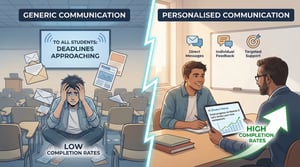

Most Registered Training Organisations spend a significant budget on SEO and paid search. Leads come in. Course guides are downloaded. The marketing looks good.
Then the quiet losses begin.
The problem is not always a matter of training quality. It is not always the trainer. In too many cases, students are lost to what I call digital friction, the invisible administrative and communications gaps that sit between enquiry and completion. Fix those gaps, and you protect margins, improve completion and turn enquiries into advocates.
Below, I map the most common digital gaps, explain the revenue impact, and show how practical HubSpot-centred solutions can close the leaks for RTOs.
The “silent killers”: admin fatigue and cognitive load
A modern student expects speed and clarity. After an enquiry, they want a clear next step, not paperwork confusion or long waits. When the effort of enrolling outweighs the perceived value of the course, people drop out. This is admin fatigue in action.
Data and industry analysis show AI and automation are making it easier to reduce friction and improve responsiveness. For example, HubSpot’s Breeze AI tools bring reporting, assistants and agents directly into the CRM so teams can act faster and more accurately. Learn more about HubSpot AI here.
McKinsey’s research into AI adoption also shows organisations are getting measurable business value from embedding AI into marketing and operations. That context makes automation investment a practical priority, not a novelty. Find McKinsey’s Research Paper here.
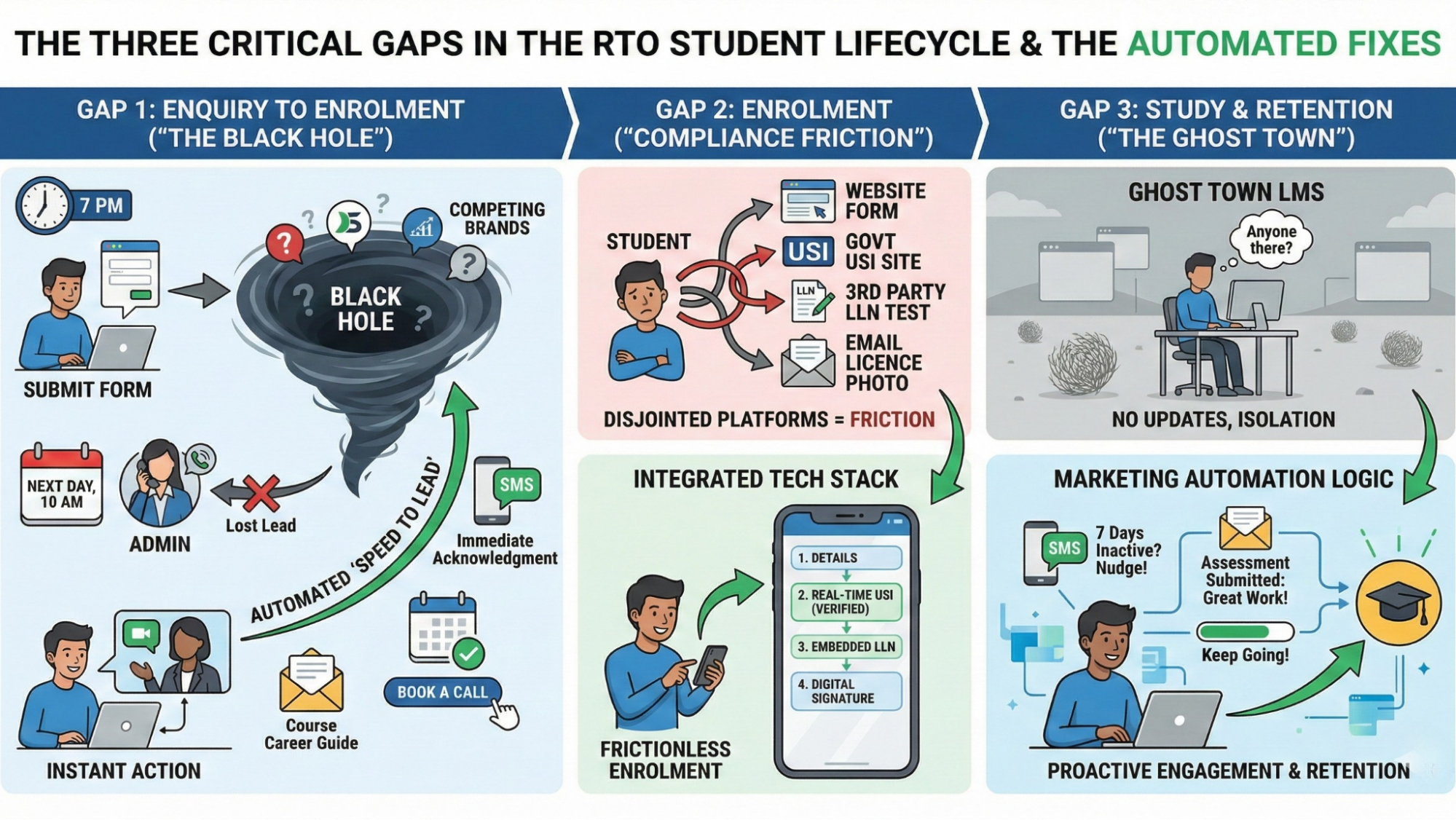
Gap #1: The "Black Hole" Between Enquiry and Enrolment
The problem
A prospect submits an enquiry and then waits. Even a single business day of delay damages conversion probability. Students are working adults; they compare options, follow up with competitors and decide quickly.
Immediate fixes
- Automate speed to lead: send an immediate SMS plus an email that explains next steps and offers to book a call.
- Include a value resource instantly, for example, a short course outcomes PDF or a fee breakdown.
- Allow direct calendar booking in the first message to make scheduling frictionless.
These are low-cost changes that produce fast returns.
Gap #2: The Compliance Friction
The problem
RTOs must collect USIs, LLN results and verify ID. When you force students to leap between a website form, a government portal and a third-party LLN provider, you lose people.
How to reduce the pain
- Integrate USI and LLN checks into the enrolment path so students complete everything in one mobile-friendly flow. The official USI service explains the requirement and how students obtain their USI if needed. Unique Student Identifier (USI).
- Use digital signatures so students can sign on their phone without printing, scanning or emailing.
- Make the process mobile-first; if the enrolment path is not smooth on a smartphone, you are actively losing revenue.
Technically, these fixes are an integration problem. Practically, they are a conversion and retention win.
Gap #3: The "Ghost Town" Effect During Study
The problem
Once training starts, many RTOs dial back marketing and communications. Students submit assessments and then hear nothing for days. That silence looks like a lack of oversight, and engagement drops.
How to fix it
- Apply lifecycle marketing to the student journey. Automate nudges based on LMS activity. For example, if a learner has not logged in for seven days, send a friendly SMS check-in. If an assessment is submitted, send an immediate acknowledgement with clear marking timelines.
- Use trainers’ macros and short personalised messages to scale empathy. Automation should feel human, not robotic.
The revenue case: why closing gaps matters
Fixing the digital gaps improves unit economics.
Example: if your cost per lead is $100 and your conversion rate is 10 per cent, the cost per enrolment is $1,000. If you lift conversion to 15 per cent by closing gaps, the cost per enrolment falls to $666. That improvement comes from process change, not additional ad spend.
Improved completion rates also protect funding, reduce clawbacks and increase lifetime student value through future course uptake and referrals.
Actionable Steps for RTO Managers
To fix these gaps, you need to audit your current state.
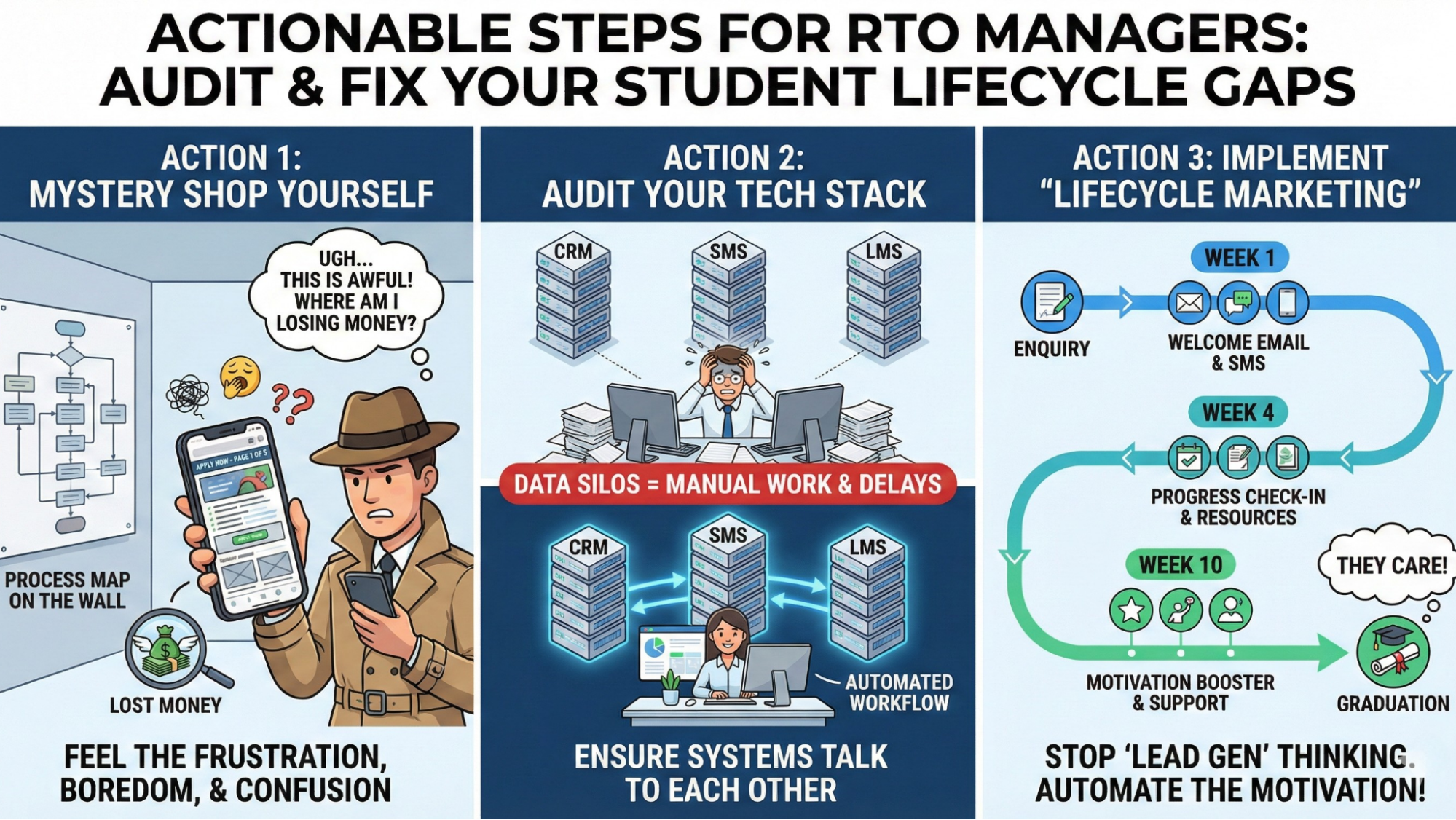
1. Mystery Shop Yourself
Don't just look at the process map on your wall. Actually, apply for your own course. Do it on a mobile phone. Note every time you feel frustrated, bored, or confused. That is where you are losing money.
2. Audit Your Tech Stack
Do your systems talk to each other? If your CRM doesn't talk to your SMS, and your SMS doesn't talk to your LMS, you have data silos. These silos create manual work for your staff and delays for your students.
3. Implement "Lifecycle Marketing"
Stop thinking of marketing as just "lead gen." Marketing continues until the student graduates. Map out the communication touchpoints for Week 1, Week 4, and Week 10 of their course. Automate the motivation.
Final Thought
The RTOs that will win this year and beyond are not just training providers; they are digital experience providers.
Students compare your enrolment process to their experience with Amazon, Uber, or Netflix. They expect speed, transparency, and ease of use.
If you leave gaps in your digital journey, your competitors will fill them.
By mapping the student journey and using automation to bridge the gaps between enquiry, enrolment, and completion, you build a resilient business model that scales.
You reduce the load on your admin team. You increase student satisfaction. And most importantly, you turn interest into impact.