Let’s be honest for a second. The way most Registered Training Organisations (RTOs) communicate with students is broken.
For years, the industry has relied on the "broadcast" model. You send a generic newsletter or a standard orientation email to 5,000 students and hope for the best. You assume that because you sent it, they read it.
But the data says otherwise.
New research from the National Centre for Vocational Education Research (NCVER) shows that completion rates for VET qualifications are approximately 49%. That means half the people who start a course with you won’t finish it.
That isn't just an academic metric; it’s a financial disaster. Students usually don't drop out because the coursework is too hard. They drop out because they feel invisible.
If you want to fix your retention rates and your bottom line, you need to stop broadcasting and start connecting. Here is why personalised communication is the single biggest lever you can pull right now.
The Real Cost of "Churn and Burn"
Most RTO owners obsess over acquisition. You spend thousands on Google Ads, education agents, and sales teams to get students through the door. But you are ignoring the leak in the bucket.
Acquiring a VET student is expensive. In the competitive Australian market, your Customer Acquisition Cost (CAC) is likely sitting between $3,000 and $7,000 per student
That cost is front-loaded. You spend the money before the student pays their full fees.
- Scenario A: Student enrols. Cost is $3,000. They finish the course. You make a profit.
- Scenario B: Student enrols. Cost is $3,000. They drop out after one term. You lose money.
If you have a high attrition rate, you are paying students to leave. Retaining an existing student costs 70-80% less than finding a new one. If you can bump your retention up by just 5%, you can increase your profitability by anywhere from 25% to 95%.
Why Generic Broadcasts Are Failing You
The old "spray and pray" method of emailing your entire database doesn't work anymore.
In the education sector, the average email open rate hovers around 20-25%. That means for every 100 students you send a critical update to, 80 of them never see it.
If you send a generic email about a census date and 80% of your cohort misses it, you have failed to communicate.
Worse, you are creating "alert fatigue." When you send irrelevant info like reminding a student to enrol in a unit they’ve already finished, you train them to ignore you. So when you finally send something important, like "Your course progression is at risk," they’ve already tuned out.
The Power of "Hey, I Noticed..."
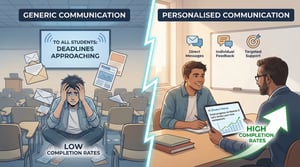
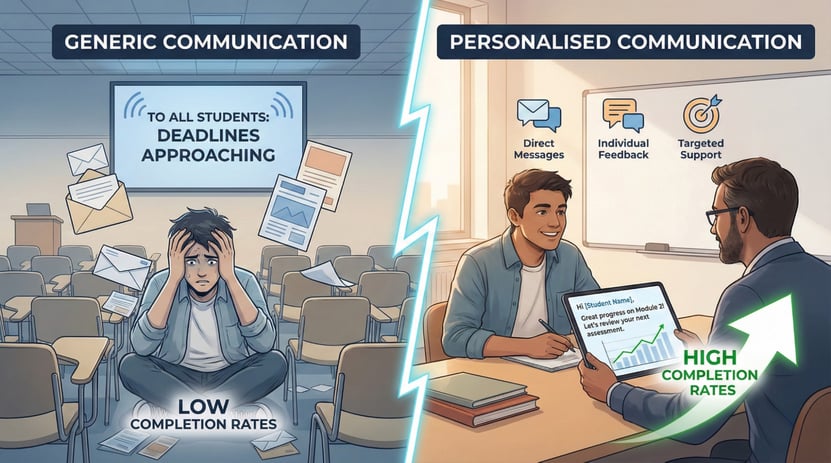
Personalisation flips the script. It changes the dynamic from "informing the herd" to "coaching the individual."
Consider the difference:
- Generic Email: "Dear Student, Assessment 3 is due on Friday."
- Personalised SMS: "Hi Sarah, we noticed you haven't submitted Assessment 3 yet. It's due Friday. Do you need a hand with the 'Financial Reporting' section? Reply YES for a call."
The second message acknowledges who they are and where they are stuck. It creates a psychological contract of care.
Does it work? Absolutely.
Research shows that timely, personalised interventions can increase attendance and assignment submission by over 7%. In the VET sector, where learners are balancing work and life, that extra nudge is often the difference between dropping out and completing their studies.
SMS: The Secret Weapon
If you are relying solely on email, you are fighting with one hand tied behind your back. You need to integrate SMS.
The stats don't lie:
- Open Rates: SMS gets a 98% open rate, compared to 20% for email.
- Speed: 90% of texts are read within 3 minutes.
- Response: SMS gets a 45% response rate versus email's 6%.
When a student is at risk of disengaging, time is the enemy. An email might sit in their inbox for a week. An SMS gets read immediately.
Use SMS for the urgent stuff: deadlines, attendance alerts ("Class starts in 1 hour!"), and re-engagement ("We haven't seen you online in 7 days"). Save email for the long-form policy updates.
Automation is the Engine
You might be thinking, "I don't have time to write personal texts to 500 students."
You don't have to. Personalisation isn't manual labour; it's automation.
You need a solid CRM (Customer Relationship Management) system that talks to your LMS (Learning Management System).
- The Trigger: The LMS notices a student hasn't logged in for 10 days.
- The Action: The CRM automatically sends a "check-in" SMS from the trainer's account.
- The Result: The student replies, and the trainer steps in to help.
This allows you to segment your students. Instead of one list, you have dynamic lists: "At-Risk," "High Achievers," "Behind Schedule." You can tailor your message to fit the group.
AI is taking this a step further. Predictive analytics can now flag a student as "at-risk" weeks before they actually drop out, based on subtle changes in their behaviour. This gives you the chance to save the student (and the revenue) before it's too late.
Your 3-Step Action Plan
Stop treating retention as a mystery and start treating it like a process.
- Audit Your Data: Ensure your student contact details are clean. If you have the wrong numbers, you have no strategy.
- Automate the Nudges: Map out the "danger zones" in your course (e.g., Unit 4, or 3 months in). Set up automated SMS check-ins for those specific moments.
- Train for Empathy: Technology is just the delivery mechanism. Ensure your trainers understand that a quick, personal message can change a student's trajectory.
Final Thoughts
The era of the generic broadcast is over. To dominate the market, you must strike a balance between high-tech automation and high-touch care. Start talking to your students, not at them.
If you're looking for more detailed insights on what most RTO’s are missing, be sure to read our blog on Digital Gaps in the Student Journey: What RTOs Are Missing Between Enquiry and Completion.