Artificial intelligence is rapidly becoming embedded in everyday business software. CRM platforms, marketing tools, and customer support systems are all evolving to include AI capabilities.
But not all AI tools operate in the same way.
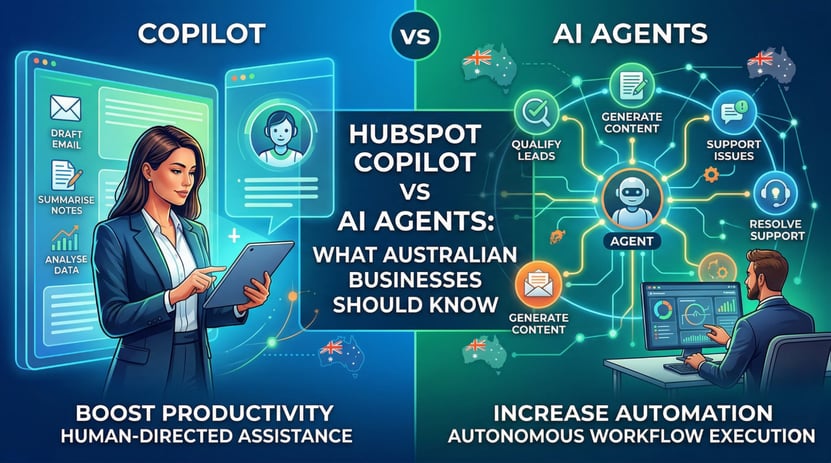
Within the HubSpot ecosystem, two terms are increasingly appearing in conversations about automation and productivity: Copilot and AI Agents.
Understanding the difference between these technologies is important for Australian businesses evaluating how to integrate AI into their marketing, sales, and operations.
The Shift from AI Assistants to AI Agents
For several years, most AI tools functioned primarily as assistants. They helped users complete tasks faster but still required direct instructions.
This is often referred to as the “copilot” model.
In contrast, newer systems are moving toward AI agents that can execute tasks independently once a goal is defined.
HubSpot’s AI framework illustrates this transition clearly. Its Breeze AI system includes both Copilot-style assistants and autonomous AI agents embedded within the CRM platform.
This shift reflects a broader trend in enterprise software where AI moves from assisting humans to completing parts of workflows automatically.
What Is HubSpot Copilot?
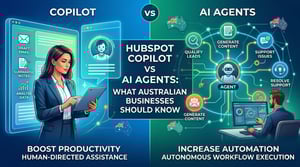
In simple terms, a copilot is an AI assistant that works alongside a user.
HubSpot’s Copilot provides recommendations, generates content, summarises information, and answers questions about CRM data. It acts as a conversational interface within the platform.
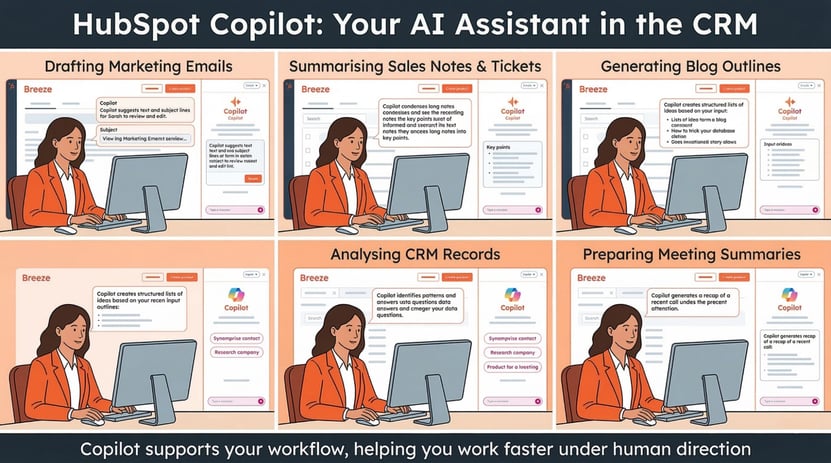
Examples of typical Copilot tasks include:
- Drafting marketing emails
- Summarising sales notes or support tickets
- Generating blog outlines
- Analysing CRM records
- Preparing meeting summaries
The key point is that Copilot supports a user’s workflow rather than replacing it.
It helps people work faster but still requires human direction.
What Are AI Agents?
AI agents represent a different level of automation.
Rather than waiting for instructions, agents are designed to complete tasks autonomously once given an objective.
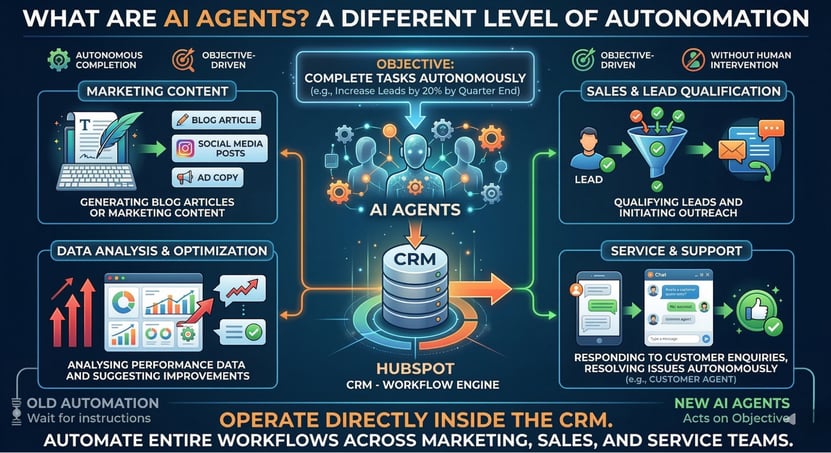
Within HubSpot, AI agents can perform actions such as:
- generating blog articles or marketing content
- qualifying leads and initiating outreach
- responding to customer enquiries
- analysing performance data and suggesting improvements
These agents operate directly inside the CRM and can automate entire workflows across marketing, sales, and service teams.
For example, HubSpot’s Customer Agent can automatically respond to support enquiries and resolve many customer issues without human intervention.
Copilot vs AI Agents: The Key Differences
Understanding how these tools differ helps businesses determine where they deliver the most value.
|
Feature |
Copilot |
AI Agents |
|
Role |
AI assistant |
Autonomous digital worker |
|
Interaction |
Requires prompts or instructions |
Executes tasks automatically |
|
Scope |
Helps with individual tasks |
Manages complete workflows |
|
Example |
Drafting a marketing email |
Running a lead qualification process |
- Copilots increase productivity.
- Agents increase automation.
- Most organisations will use both.
Why This Matters for Australian Businesses
Australian SMEs often operate with smaller teams and limited operational resources.
This makes automation particularly valuable.
Instead of hiring additional staff to handle repetitive tasks, businesses can use AI tools to improve efficiency and responsiveness.
AI agents are especially relevant in areas such as:
- marketing automation
- lead qualification
- customer support
- sales follow-ups
These activities often consume significant time but follow predictable processes.
Automating these activities allows teams to focus on strategy, relationship building, and decision-making.
Practical Examples of AI in Marketing and CRM
To illustrate the difference, consider two common marketing scenarios.
Scenario 1: Content Creation
A marketing manager asks Copilot to generate a draft blog post based on campaign data. The assistant produces an outline and suggests copy.
The human then reviews, edits, and publishes the content.
Scenario 2: Lead Qualification
An AI agent monitors website visitors, identifies high-intent prospects, initiates chat conversations, schedules meetings, and updates the CRM automatically.
The sales team receives qualified leads rather than raw enquiries.
These two approaches complement each other rather than compete.
Why CRM Integration Matters
A major advantage of AI tools embedded within CRM systems is access to contextual data.
Because HubSpot’s AI tools operate inside the CRM, they can analyse customer interactions, deal stages, and marketing activity to provide relevant insights.
Research shows that organisations using unified CRM platforms experience improvements in lead generation, sales conversion, and customer support efficiency.
This integration is one reason AI adoption is accelerating among small and mid-sized businesses.
What Australian RTOs Should Pay Attention To
For Registered Training Organisations, the potential impact is significant.
RTOs manage complex processes including student enquiries, application workflows, compliance documentation, and ongoing communication with learners.
AI tools integrated with CRM platforms can help automate parts of this journey.
Examples include:
- responding instantly to course enquiries
- qualifying prospective students
- scheduling admissions calls
- tracking application progress
- sending automated reminders for incomplete enrolments
This aligns closely with issues discussed in our article “Mapping the Student Enrolment Journey: Identifying Critical Drop-Off Points for RTOs.”
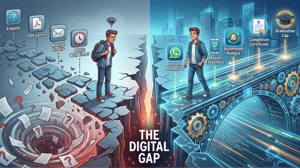
Many RTOs lose students during administrative processes rather than marketing stages. Improving digital workflows can significantly increase enrolment conversion.
Preparing Your Business for AI-Driven Workflows
Businesses considering AI adoption should approach it strategically.
Some practical steps include:
- Centralise customer data in a CRM platform
- Identify repetitive tasks that can be automated.
- Start with AI assistants before introducing autonomous agents.
- Ensure staff understand how AI tools support their workflows.
AI should enhance human capability rather than replace it entirely.
The organisations that succeed will be those that combine automation with strong customer understanding.
Final Thoughts
The evolution from AI assistants to autonomous AI agents represents an important shift in business technology.
Copilots help people complete tasks faster.
Agents allow systems to complete tasks independently.
Together, they create a hybrid model where humans focus on strategy while AI handles routine operational work.
For Australian businesses exploring digital transformation, understanding this distinction is the first step toward building smarter, more efficient systems.