
Service businesses are busy by design.
There are enquiries to respond to, meetings to schedule, proposals to send, clients to onboard, and relationships to maintain.
The challenge is not effort. It is repetition.
That is why workflow automation inside a CRM platform like HubSpot delivers such strong operational value. Instead of replacing people, automation removes predictable administrative steps so teams can focus on conversations that move projects forward.
Below are five practical HubSpot workflows that service businesses across Australia can implement quickly to improve responsiveness, conversion rates, and client experience.
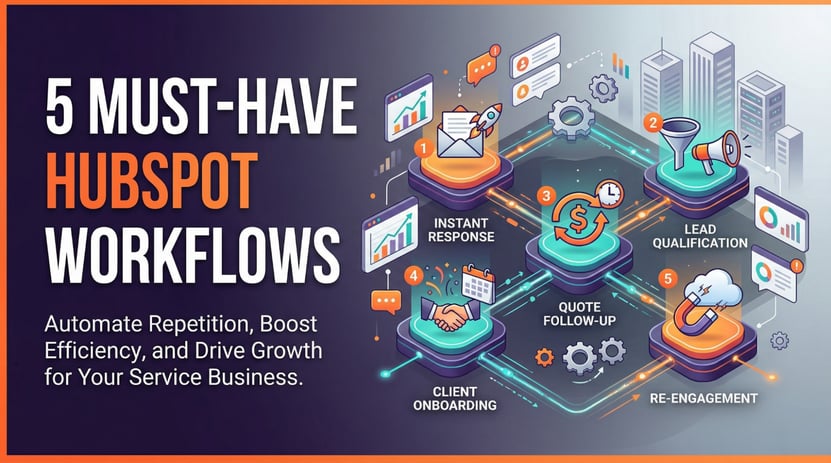
1. Instant enquiry response workflow
Speed-to-lead remains one of the most important conversion factors for service businesses.
When someone submits a website enquiry, they are usually comparing multiple providers at the same time. A delay of even a few hours can reduce engagement significantly.
An enquiry response workflow should:
- Send a confirmation email immediately
- Notify the appropriate team member
- Include a calendar booking option
- Deliver a helpful resource relevant to the enquiry
This simple workflow improves trust before the first conversation even happens.
HubSpot’s automation tools allow these responses to trigger automatically from forms, chat conversations, or CRM contact creation events.
Research from McKinsey & Company shows organisations embedding automation across marketing and sales processes are seeing measurable performance improvements in responsiveness and efficiency.
2. Lead qualification workflow
Not every enquiry is ready to become a client immediately.
Qualification workflows help service businesses prioritise attention where it matters most.
Inside HubSpot, this workflow can:
- Assign lifecycle stages automatically
- segment contacts by service interest
- The route leads to the correct consultant
- notify teams when high-intent actions occur
Instead of treating every lead the same, your CRM begins supporting decision-making in real time.
This approach is especially valuable for businesses managing multiple service lines or working across several industries.
3. Proposal and quote follow-up workflow
One of the most common lost-revenue problems in service businesses is silent proposals.
A proposal is sent. The prospect becomes busy. The opportunity disappears.
A follow-up workflow ensures conversations continue without relying on memory.
Typical automation steps include:
- reminder email after two days
- supporting case study after five days
- internal task reminder after seven days
These workflows support consistent follow-up behaviour across teams.
According to Gartner, workflow automation continues to be a priority investment area for organisations, improving customer engagement and pipeline visibility.
4. Client onboarding workflow
Winning a client is only the beginning of the relationship.
Strong onboarding improves delivery clarity, reduces misunderstandings, and increases long-term retention.
A structured onboarding workflow inside HubSpot can:
- Send welcome communications automatically
- Introduce key contacts
- Outline project steps clearly
- Schedule kickoff meetings
- Trigger internal delivery notifications
This creates a consistent experience regardless of which team member manages the account.
For growing service businesses, consistency becomes a competitive advantage.
5. Re-engagement workflow for inactive contacts
Most service businesses already have opportunities sitting inside their CRM.
They simply have not been contacted recently.
A re-engagement workflow can:
- Identify inactive contacts automatically
- Send personalised check-in emails
- Share relevant updates or insights
- Invite contacts back into the conversation
Because these contacts already know your business, re-engagement campaigns often generate faster pipeline movement than new acquisition campaigns.
HubSpot’s CRM-embedded AI assistants can help identify these opportunities using existing engagement data and contact history.
Why HubSpot workflows matter for Australian service businesses
Many Australian service organisations operate with lean teams.
Automation allows those teams to scale without increasing administrative overhead.
Instead of hiring additional staff to manage routine follow-ups and coordination tasks, workflow automation supports:
- Faster response times
- Stronger pipeline visibility
- Improved client onboarding
- Better lifecycle engagement
HubSpot’s AI-supported automation tools are designed to integrate directly into CRM workflows so teams can manage marketing, sales, and service activity inside one platform. (HubSpot product overview)
This unified structure is one reason CRM-based automation adoption continues to increase among small and mid-sized businesses globally.
Where service businesses should start
The most effective approach is staged implementation.
Start with:
- enquiry response automation
- qualification workflows
- proposal follow-ups
- onboarding automation
- re-engagement campaigns
Each workflow builds operational momentum and improves visibility across the customer journey.
Related reading on ibusinessformula.com.au
To explore how HubSpot automation fits into a broader AI-enabled CRM strategy, see:
- HubSpot AI Tools for Small Business: A Practical Guide
- The Agentic Era of Marketing: Why Campaign-Only Strategies Are Losing Ground
- Mapping the Student Enrolment Journey: Identifying Critical Drop-Off Points
- Digital Gaps in the Student Journey: What RTOs Are Missing Between Enquiry and Completion
Together, these articles form part of a practical content cluster explaining how automation improves marketing performance and operational efficiency across Australian service organisations.