Most of your next clients will check you out online before they pick up the phone. They search Google, read your reviews, scroll your project photos and, more and more often, ask an AI tool for a shortlist of builders.
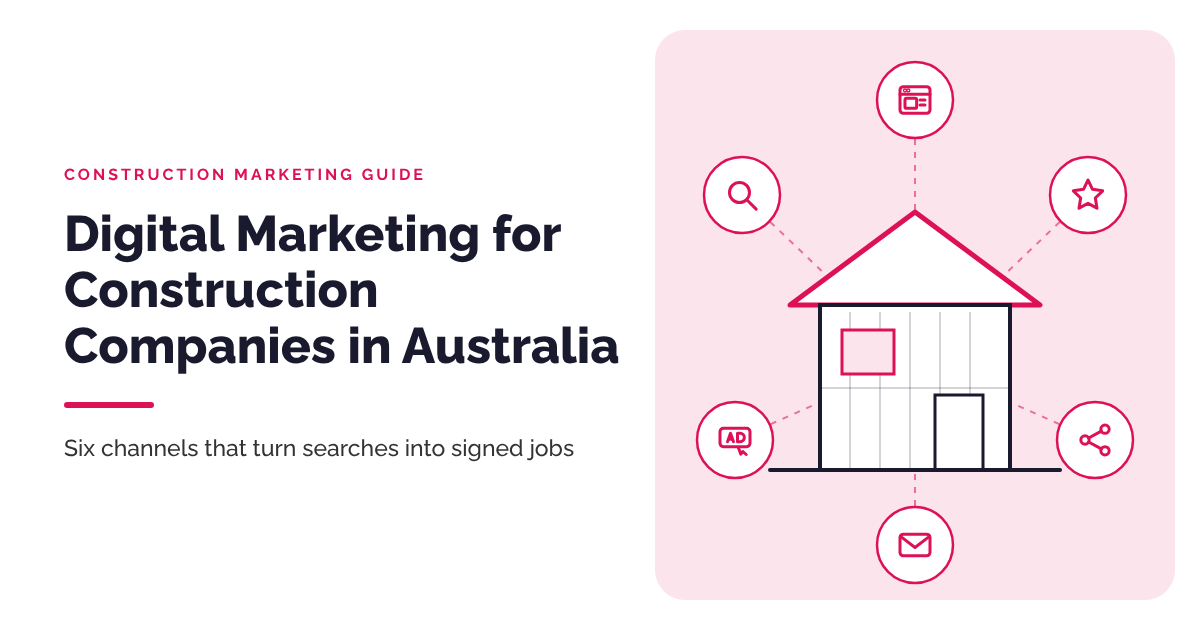
Digital marketing for construction companies in Australia is the set of online channels that turns those searches into quote requests. It covers your website, Google Business Profile and reviews, SEO, Google Ads, social media and email follow-up. Done well, it gives you a steady flow of enquiries that doesn't depend on the next referral.
We've seen what happens when those channels work together. When iBusinessFormula set up HubSpot, automated follow-up, and a content marketing plan for Todd Devine Homes, a Sydney residential builder, website sessions grew from 4,500 in 2022 to 10,750 in 2025, and leads grew from 80 to 210.
This guide covers each channel in plain English, where traditional marketing still fits, and how to tell which channel is actually winning you jobs. It's one part of our wider playbook on how to grow a construction business in Australia.
What is digital marketing for construction companies?
Digital marketing for construction companies is the use of online channels to attract people planning a build or renovation and turn their enquiries into signed jobs. Those channels are your website, Google Business Profile, search engine optimisation, Google Ads, social media and email, and they work alongside referrals rather than replacing them.
The big difference from traditional marketing is measurement. A site sign might bring in work, but you rarely know how much, while digital channels show you which search, ad or email produced each enquiry.
The right mix depends on who you build for. Residential builders usually win most from local search and reviews. Commercial contractors lean on LinkedIn and relationships with developers and project managers, while trade subcontractors often need little more than a strong Google Business Profile and fast replies to head contractors.
If lead volume is your biggest worry, our guide on how construction companies get more leads goes deeper on the enquiry side.
Traditional marketing for construction companies in Australia: what still works
Before you move budget online, look at what already wins you work. For most builders, traditional marketing for construction companies means referrals, site signage, branded vehicles, display homes, home shows, and relationships with architects, designers and real estate agents.
These channels work because building is a trust purchase. A homeowner who walks past your site board every morning, or hears your name from a neighbour, arrives warmer than any ad click.
The catch is competition and control. There were 478,651 construction businesses trading in Australia on 30 June 2026, up 3.4% in a year, according to the Australian Bureau of Statistics. Word of mouth alone rarely separates you from the builder down the road, and when a referral source goes quiet, enquiries drop with no warning and no data to explain why.
That's why we recommend treating traditional marketing as your trust layer and digital as your demand layer. Link the two: put your website address and a QR code to your enquiry form on every site board, so the people who notice your work can act on it.
The six digital marketing channels that win construction jobs
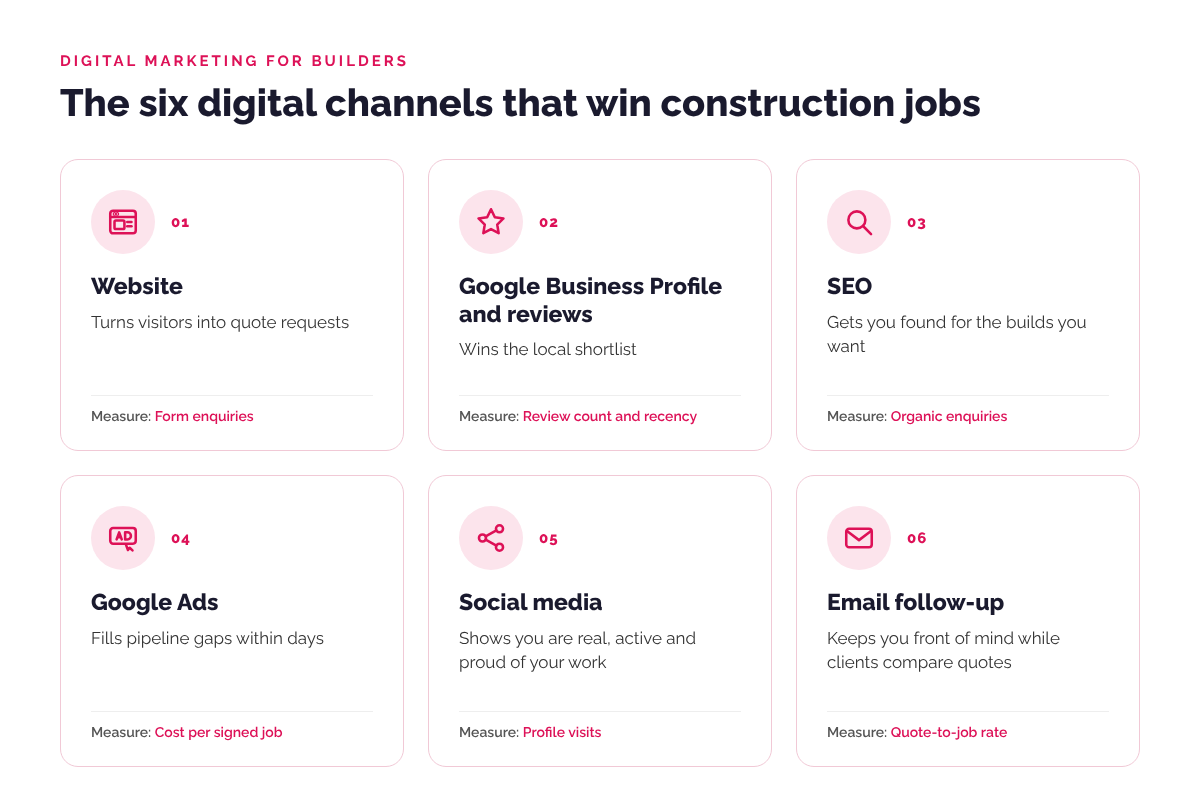
Digital marketing for construction companies covers six channels, but not every channel deserves your money on day one. Below is what each one does for a builder, in the order we recommend setting them up, with a pointer to a detailed guide for each.
1. Your website: where visitors become quote requests
Your website has one job: turn a visitor into a quote request. BrightLocal's 2026 Local Consumer Review Survey of US consumers found 54% visit a business's website after reading positive reviews. A weak site loses those people at the exact moment they're ready to act.
We recommend checking four things first:
- An enquiry form on every service and project page that asks for suburb, project type and rough budget, so your estimator can triage before calling back.
- A project gallery with real photos, the suburb and a two-line description of the scope.
- Your builder's licence number, insurance and industry association memberships, shown clearly in the footer.
- Pages whose main content loads in under 2.5 seconds on a phone, Google's "good" threshold. Our guide to improving website speed shows how.
If you're still choosing the tools behind your website and your jobs, our guide to what software builders use in Australia compares the options honestly.
2. Google Business Profile and reviews: winning the local shortlist
For a search like "home builder near me", your Google Business Profile often appears before your website does. Treat it as a second homepage: accurate service areas, real project photos, correct hours and a link straight to your enquiry form.
Reviews decide who gets the call. In BrightLocal's 2026 survey of US consumers, 97% read reviews for local businesses and 47% wouldn't use a business with fewer than 20 reviews. Recency matters too: 74% only cared about reviews from the last three months.
That recency figure is the real challenge for a builder who finishes a few dozen jobs a year, because a burst of reviews from 2023 no longer counts. Ask at every handover, in person, then send the review link that evening, and reply to every review you receive. Our guide to getting Google reviews for your construction business covers the scripts and timing in full.
3. SEO: being found for the builds you want
SEO (search engine optimisation) helps your website appear in Google's free results when people search for the type of build you do, where you work. For builders, the best returns usually come from one well-built page per service and region you genuinely want more of, each showing real local projects.
SEO is slow. In our own content programme, we plan on three to six months for less competitive searches and six to nine months for competitive ones. That's why we recommend starting early and keeping Google Ads running while it builds.
AI search raises the stakes: BrightLocal found 45% of US consumers now use tools like ChatGPT for local business recommendations, up from 6% a year earlier. Those tools draw on the same website content, listings and reviews that good SEO improves, and our guide to SEO for construction companies goes deeper.
4. Google Ads: enquiries this week, not next quarter
Google Ads puts you at the top of the results for searches you choose, and you pay each time someone clicks. It's the fastest way to generate enquiries, which makes it the right tool when you can see a gap in your pipeline six weeks out.
The risk is paying for clicks that never become jobs. We recommend starting narrow:
- A handful of high-intent searches, such as "custom home builder" plus the suburbs you build in.
- A target area that matches where you actually work, not your whole state.
- Negative keywords like "jobs", "apprenticeship," and "DIY", so job seekers and DIY renovators don't use up your budget.
- A dedicated landing page with a quote form, never your homepage.
Judge the campaign on cost per signed job, not cost per click, because cheap enquiries that never convert cost more than fewer, better ones. Our guide to Google Ads for construction companies covers budgets and tracking.
5. Social media: proof that you're real and busy
Social media rarely produces a quote request on its own for a builder. It's where prospects go to check that you're active and proud of your work. BrightLocal found that 24% of US consumers visit a business's social media channels after reading positive reviews.
Match the platform to the buyer. Residential builders do well on Instagram and Facebook with before-and-after photos, short site walkthroughs and handover moments. Commercial contractors and subcontractors get more from LinkedIn, where developers, project managers and architects spend their time.
We recommend setting a pace you can keep, such as one project post a week, rather than a burst that stops when the next job starts. Get written permission before posting a client's home. Check every photo for site safety too: one shot of a worker without the right protective equipment does more damage than no post at all.
6. Email follow-up: staying in touch while clients decide
Most construction enquiries don't sign after the first conversation. Projects take months to plan, finance and approve, and the builder who stays in touch through that period is the one still on the shortlist.
Email does this without your estimator chasing every lead by hand. A short automated welcome series, with a few emails spaced a week apart and a personal note from the owner, keeps you front of mind while the client decides.
Past clients deserve a short update a few times a year too, because they're your best source of referrals and repeat work. Before you send anything, follow the ACMA's spam rules: get consent, identify your business in every message, and include a working unsubscribe that you action within five working days.
Our guides to following up with construction leads and email marketing for construction companies cover the full process.
Which digital marketing channel should a builder start with?
If you're starting from scratch, we recommend this order: website, then Google Business Profile and reviews, then email follow-up, with Google Ads added when you need enquiries fast. Start SEO early because it takes the longest, and run social media alongside at a pace you can sustain.
|
Channel |
Best for |
Time to first results* |
What to measure |
|
Website |
Every builder |
As soon as it's live |
Enquiry form submissions |
|
Google Business Profile and reviews |
Residential builders and trades |
Weeks |
Calls, review count, review recency |
|
SEO |
Builders with a defined service area |
Three to nine months |
Enquiries from organic search |
|
Google Ads |
Filling short-term pipeline gaps |
Days |
Cost per signed job |
|
Social media |
Trust and proof; LinkedIn for commercial work |
Months |
Profile visits and direct messages |
|
Email follow-up |
Converting quotes and winning repeat work |
Weeks |
Quote-to-job rate |
Digital marketing for construction companies: channel comparison
How to know which channel is actually winning you jobs
The most common mistake we see is a builder spending across four channels and judging them by gut feel. The office remembers the ad enquiry that went nowhere and forgets the three jobs that came from a Google search.
The fix is to send every enquiry, from every channel, into one CRM (customer relationship management system). Each lead is tagged with its source and followed through to a quote and a signed job. You can then see which channel produced revenue and what each job cost to win.
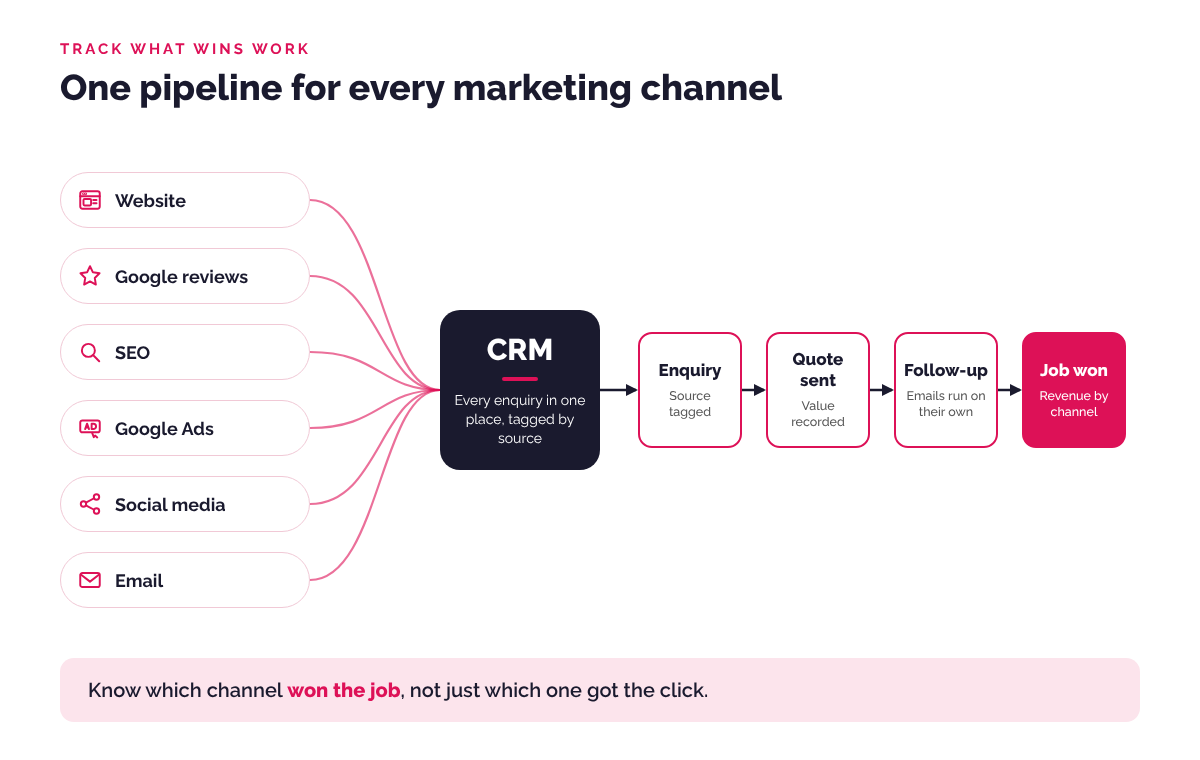
HubSpot handles this well for builders because forms, email, ad reporting and the sales pipeline sit in one platform. Tailored Homes, a Sydney design and build company, now captures every enquiry from Facebook lead forms, its website and referrals in HubSpot, with the source recorded, before qualified leads move into its estimating software.
If your bigger problem is scheduling crews and costing jobs, a job management tool such as Tradify, ServiceM8 or Buildertrend may be the better first purchase, and plenty of builders run one alongside a CRM.
Our guides to what a CRM for construction companies is, job management software for construction and the best CRM for construction companies in Australia explain the differences.
Construction company marketing tips for Australian builders
These construction company marketing tips cost little and work across every channel above. We recommend picking two this month rather than all eight at once.
- Reply to every web enquiry on the same business day. Set an automatic acknowledgement so the client knows a person will call.
- Ask for a Google review at handover. Ask in person, then send the link that evening.
- Photograph every job at four stages: site start, frame, lock-up and handover. That gives you a month of weekly posts from every project.
- Add a QR code to every site board that opens your enquiry form, not just your phone number.
- Build pages for the work you want more of, not one page listing everything you've ever built.
- Record the source of every enquiry, even if it's one column in a spreadsheet to start.
- Keep marketing running in busy months, at a lower level, so you're not starting from zero when work slows.
- Put your licence number and insurance on every quote, as well as on your website.
Frequently asked questions about digital marketing for construction companies
Which digital marketing channel works best for builders?
For most residential builders, Google Business Profile and reviews produce the best return first, because they decide who makes the local shortlist. Commercial contractors usually do better with LinkedIn and direct relationships. Whatever you choose, your website must turn visitors into quote requests, or every other channel leaks.
Is social media worth it for a construction business?
Yes, as proof rather than as a lead source. Prospects check your Instagram, Facebook or LinkedIn to confirm you're active and doing quality work. One honest project post a week, with client permission and safe site practices visible, does more than daily posts that stop after a month.
Should a builder use Instagram or LinkedIn?
It depends on who signs your contracts: residential builders and renovators reach homeowners on Instagram and Facebook, where before-and-after photos and handover moments do the work, while commercial contractors and subcontractors reach developers, project managers and architects on LinkedIn. Most builders only need one main platform done well.
How long does SEO take for a construction company?
SEO takes months, not weeks. We plan on three to six months for less competitive local searches and six to nine months for competitive terms. Run Google Ads while SEO builds, so your pipeline doesn't depend on rankings you don't have yet.
Do QR codes on site boards work?
They work best when they open a short mobile enquiry form rather than your homepage. Add a tracking link to the QR code so enquiries from site boards are recorded as their own source in your CRM. That way you'll see whether your boards actually bring in work, instead of guessing.
Should I do digital marketing myself or hire an agency?
Do the basics yourself: your Google Business Profile, review requests and project photos. Consider outside help for Google Ads, SEO and CRM setup, where mistakes cost money quickly. If you hire an agency, choose one that reports on signed jobs, not just clicks and impressions.
Next steps: pick one channel and measure it
Digital marketing for construction companies doesn't need to be complicated. Pick the weakest channel in your setup today, fix it this month, and start recording where every enquiry comes from.
If you want a second opinion, our Business Growth Audit looks at your website, reviews, follow-up and pipeline, and shows you where enquiries are slipping away.