Knowing how to start a construction company in Australia comes down to six steps: choose a business structure and get an ABN, obtain the builder licence or registration your state requires, arrange the insurance that comes with it, set up work health and safety (WHS) systems, register for the right taxes, and build a system for winning and tracking work before your first job lands.
The first five are legal requirements. The sixth is optional on paper, and it is where a lot of new builders get stuck.
This guide covers each compliance step in order, then the system that keeps work coming in once you are legal and operating.
What do you need to start a construction company in Australia?
To start a construction company in Australia, you need a registered business structure with an ABN, a builder licence or registration from your state or territory regulator, the insurance your licence and contracts require, WHS systems including white cards and safe work method statements, and the right tax registrations. Licensing rules differ between states, so your location decides the details.
- Choose your business structure and register for an ABN.
- Get licensed or registered with your state or territory regulator.
- Arrange the insurance your licence and contracts require.
- Set up WHS systems before anyone steps on site.
- Register for tax and set up contractor reporting.
- Build your lead, quote and job tracking system before your first job.
Business.gov.au also runs the Australian Business Licence and Information Service (ABLIS), which lists the licences and permits that apply to your business by location and activity. Run an ABLIS search before spending money on anything else.
What does the Australian construction market look like for new builders?
Construction recorded 76,414 new businesses in 2024-25, the most of any industry, according to the Australian Bureau of Statistics.
In 2025-26, 3,472 construction companies entered external administration, close to a quarter of all company insolvencies in Australia, based on ASIC data reported by Accountants Daily. You are walking into a crowded market with very little room for slow quotes or forgotten follow-ups.
Master Builders Australia reports that 462,939 construction businesses were operating in Australia as of June 2025, and 98.6% of them had fewer than 20 employees. Most of your competitors are small operators like you, often with the owner quoting at night after a day on site.
A licence proves you are allowed to build. It does nothing to bring in the next job.
In a market like that, the builder who responds first, sends a clear quote and follows up on schedule wins jobs that have nothing to do with price. The trap for a new company is running enquiries through a personal mobile, quotes through a spreadsheet and follow-ups through memory.
That holds up for your first few jobs. It falls apart when volume picks up, which is exactly when you can least afford to lose a lead.
The 6 steps to start a construction company in Australia
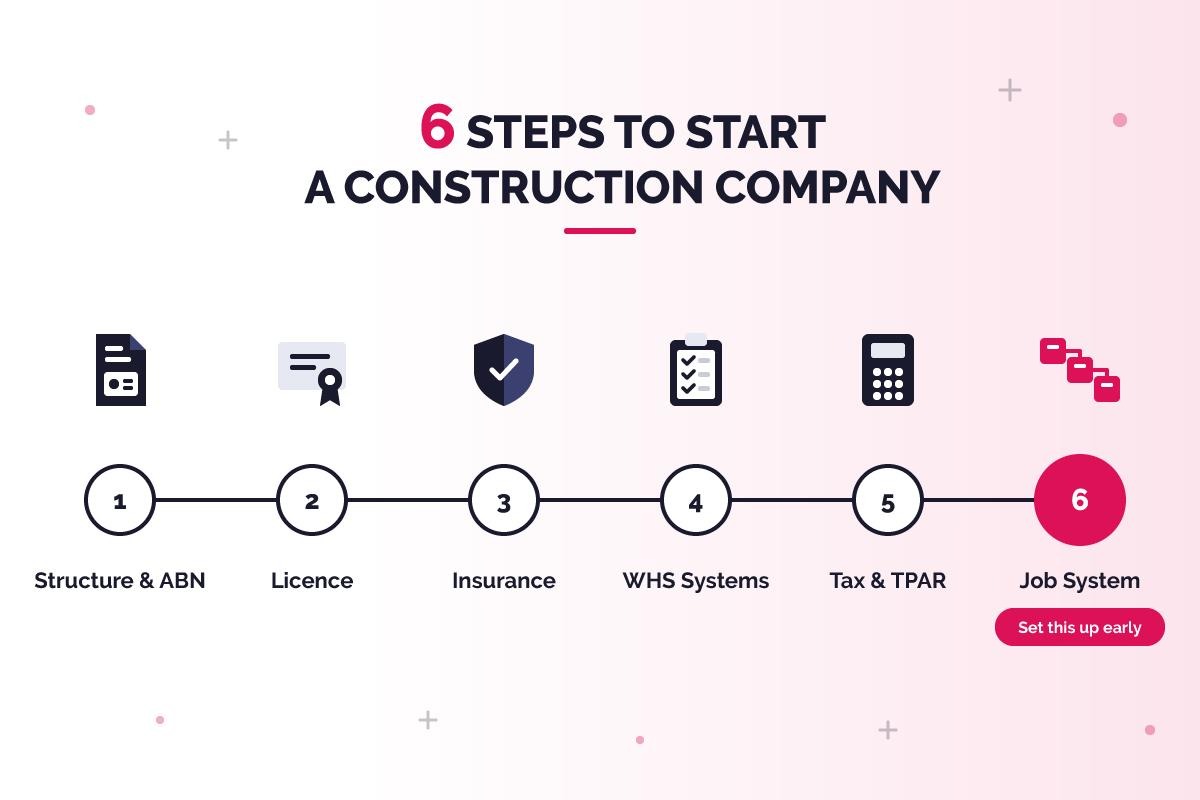
Work through these in order. Steps 1 to 5 make your company legal; Step 6 makes it ready to win work.
Step 1: Choose your business structure and register it
Your options are sole trader, partnership, company or trust. The choice affects your tax, your personal liability and, in construction, your licence.
That last point catches people out. In New South Wales, a company or partnership doing residential building work needs its own contractor licence, separate from an individual licence. In Western Australia, a registered building practitioner cannot contract directly with clients; the business needs building contractor registration, with a nominated supervisor at all times.
Talk to your accountant and your state regulator together before you register, so the structure you pick matches the licence you need. Once you have decided:
- Apply for an ABN through the Australian Business Register at abr.gov.au. You can register for GST in the same application.
- Register a business name with ASIC if you will trade under anything other than your own name.
- Register for GST once your GST turnover reaches $75,000, or straight away if you expect to reach it in your first year. You have 21 days to register once you know you will cross the threshold.
Step 2: Get your builder licence or registration
There is no national builder licence in Australia. State, territory and local governments set the rules for construction licences and permits, and the thresholds, licence classes and qualifications differ in each one.
Even the terms change across borders. Victoria calls it builder registration. Queensland and New South Wales issue licences.
Western Australia separates practitioner registration from contractor registration. Trades such as plumbing, gas fitting and electrical work are licensed separately again.
Table: Builder licensing regulators by state and territory in Australia
|
State/territory |
Builder licensing body |
|---|---|
|
New South Wales |
|
|
Victoria |
Building and Plumbing Commission (replaced the Victorian Building Authority on 1 July 2025) |
|
Queensland |
|
|
Western Australia |
Building Services Board, supported by Building and Energy (DEMIRS) |
|
South Australia |
|
|
Tasmania |
|
|
Australian Capital Territory |
Access Canberra (Construction Occupations Registrar) |
|
Northern Territory |
Building Practitioners Board |
Victoria is the one to watch. The Building and Plumbing Commission was established on 1 July 2025 and brought the Victorian Building Authority, domestic building dispute resolution and the domestic building insurance arm of the VMIA into one regulator. Any guide that still sends you to the VBA is out of date.
The value of work that triggers a licence also varies. In NSW, a residential building contractor licence applies to jobs where labour and materials are worth more than $5,000 including GST. In WA, contractor registration is required for builder work valued over $20,000. Check the current figure with your regulator before you quote your first job, because these settings change.
Expect to prove qualifications and experience, and in some states your financial position. Tasmania, for example, lists a sound and stable financial background as an eligibility requirement for its building services provider licences.
Step 3: Arrange the insurance your licence requires
In construction, some insurance is a licensing condition, not just a commercial choice.
For residential work, your state may require home warranty insurance, and it goes by different names. In NSW, a contractor licence application asks for details of your insurance under the Home Building Compensation Fund. In Victoria, domestic building insurance now sits with the Building and Plumbing Commission.
Beyond that, talk to an insurance broker about public liability, tools and equipment cover, and workers compensation, which is compulsory once you employ workers and is run separately in each state. Business.gov.au's building and construction industry guide makes a good starting checklist.
Step 4: Set up WHS systems before anyone steps on site
WHS is where a new construction company takes on serious legal duties from day one, even with a crew of two.
Safe Work Australia develops the national model WHS laws, but it is a policy body, not a regulator. Enforcement sits with your state or territory regulator, such as SafeWork NSW or WorkSafe Queensland. Two obligations apply from your very first job:
- White cards. Anyone who carries out construction work must complete general construction induction training, known as the white card.
- Safe work method statements (SWMS). High-risk construction work needs a SWMS prepared before the work starts. The model Code of Practice includes a SWMS template and examples of what counts as high-risk construction work.
Here is the part most start-up guides skip. A SWMS sitting in a folder on the office laptop does not protect anyone on site. Decide now where your SWMS, inductions and white card records will live, and how a site supervisor pulls them up on a phone.
Step 5: Register for tax and set up contractor reporting
Beyond GST, construction carries a reporting obligation most industries do not. If your business primarily provides building and construction services and you pay contractors, you may need to lodge a Taxable Payments Annual Report (TPAR) with the ATO by 28 August each year.
Your business counts as primarily building and construction if 50% or more of your business income in the current or previous financial year comes from those services, or 50% or more of your business activity in the current year relates to them. For each contractor, you report their ABN, name, address and the gross amount you paid them, including GST.
This is why your records matter from the first invoice. If subcontractor details live in a text thread, August turns into a reconstruction job. Capture every contractor's ABN and each payment against the job when you engage them.
Step 6: Build your lead, quote and job tracking system
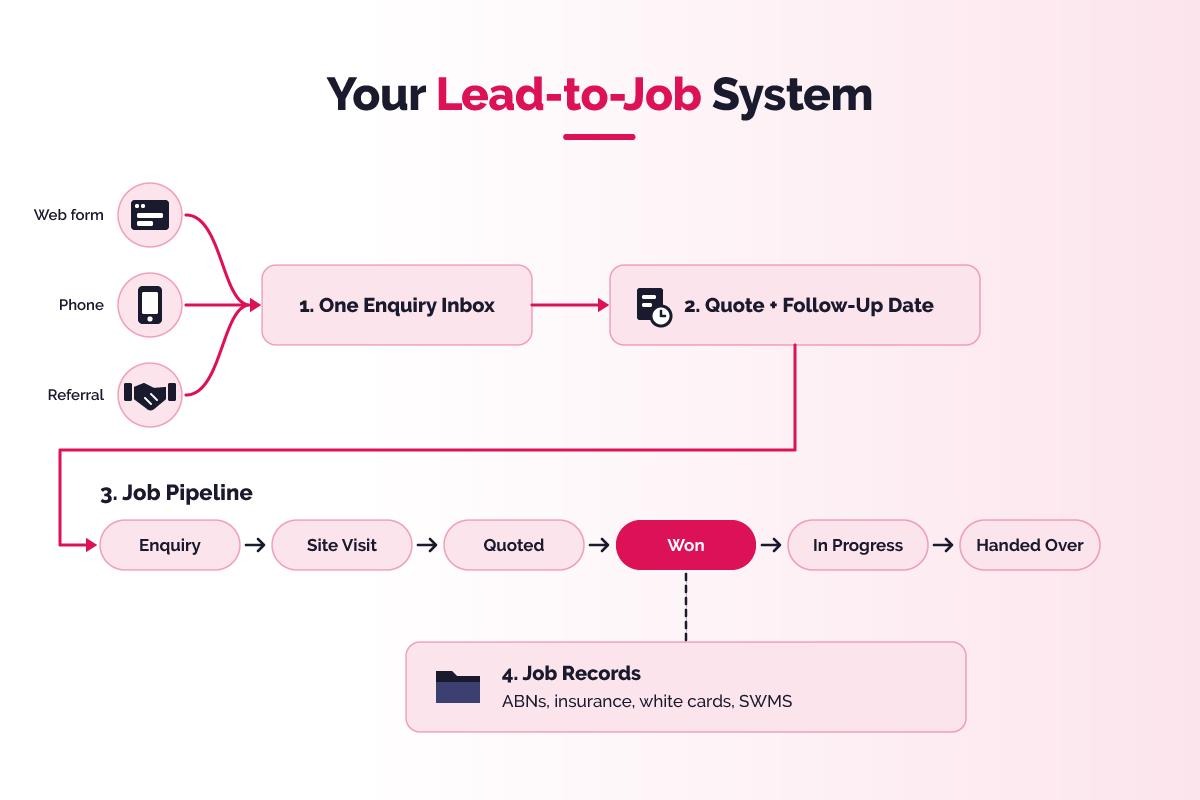
Most guides on how to start a construction company in Australia stop at Step 5. This step separates a construction company from a licensed tradesperson with an ABN. You need four things working before your first job:
- One place every enquiry lands. Website forms, calls, emails and referrals all go into the same list, so nothing sits in a voicemail.
- A quote follow-up routine. Every quote gets a follow-up date the moment it is sent, not when someone remembers.
- A job pipeline you can see at a glance. Each job moves through clear stages, such as enquiry, site visit, quoted, won, in progress and handed over, so you can see what is coming and what has stalled.
- Subcontractor and compliance records against each job. ABNs, insurance certificates, white cards and SWMS sit with the job they belong to.
Spreadsheet, job management software or a CRM?
You have three realistic options, and the honest answer depends on the work you do.
Table: Systems for a new construction company compared
|
Option |
Best for |
Where it falls short |
|---|---|---|
|
Spreadsheets and email |
Your first handful of jobs |
No automatic reminders and no shared history once more than one person handles enquiries |
|
Job management software (Tradify, ServiceM8, Buildertrend) |
Scheduling crews, job costing and invoicing |
Built around running the job; depth for nurturing leads and marketing varies by product, so check before you buy |
|
CRM platform (HubSpot, Zoho, Salesforce) |
Capturing enquiries, automating quote follow-up, tracking your sales pipeline and reporting on where work comes from |
Does not replace crew scheduling and job costing tools on its own |
A CRM for construction companies keeps every enquiry, quote and client conversation in one record and automates the follow-up. In HubSpot, that automation is called a workflow: a set of rules that, for example, reminds your estimator three days after a quote goes out if the client has not replied. A deal pipeline is HubSpot's name for the job pipeline described above.
For a new construction company focused on winning residential or commercial projects, start with a CRM for enquiries and quotes, then add job management software once you are scheduling multiple crews. If your work is mostly small, high-volume service jobs, a tool such as ServiceM8 or Tradify may cover you on its own at the start.
Case study: how Tailored Homes connected enquiries, quotes and jobs
Tailored Homes is a Sydney design and build company that takes custom homes, renovations and secondary residences from the first design brief through to handover. They were not a start-up when they came to us, and that is exactly why their story is useful. It shows what it takes to add a lead-to-job system once the business is already busy.
Before the project, they used BuildXact for estimates and job information, and Xero for invoices and supplier bills. Neither tool was set up to capture enquiries.
Leads arrived through Facebook lead ads, Messenger, website forms, email, phone and referrals, with follow-up managed manually and no shared record of who had been contacted or when, and BuildXact only saw an enquiry once it had reached the quoting stage. Anything that dropped out before that point was never recorded anywhere.
Between February and April 2026, we set it up in this order:
- One place for every enquiry. Website forms and ad leads now create or update a contact in HubSpot automatically, record the lead source, assign an owner and create a follow-up task for the sales rep.
- A visible pipeline. Each opportunity moves through stages including quotation, amendment, negotiation, won and lost, so the team can see what needs action.
- HubSpot connected to BuildXact. When a contact reaches the Appointment Booked stage, they are created as a lead in BuildXact for the estimator. The estimate status flows back into HubSpot; an accepted quote creates a deal, and a job is created in BuildXact once the deposit stage is reached.
- HubSpot connected to Xero. Invoices, payment status, supplier bills and costs are visible from HubSpot, without a separate check in Xero.
- Automatic quote reminders. A reminder goes out three days after a quote is sent and again after seven days. If the client still has not replied, the sales rep gets a follow-up task.
The result: the average time from enquiry to quote dropped from around 10 days to around 4, a reduction of about 60%. Quotes produced each month went from about 8 to about 19.
Notice what did not change. Tailored Homes kept BuildXact for estimating and Xero for their accounts.
HubSpot sits in front of both and connects them. If you are starting out, set up that front end, one place for enquiries and a follow-up rule for every quote, before your first job rather than retrofitting it later.
Common mistakes when you start a construction company in Australia
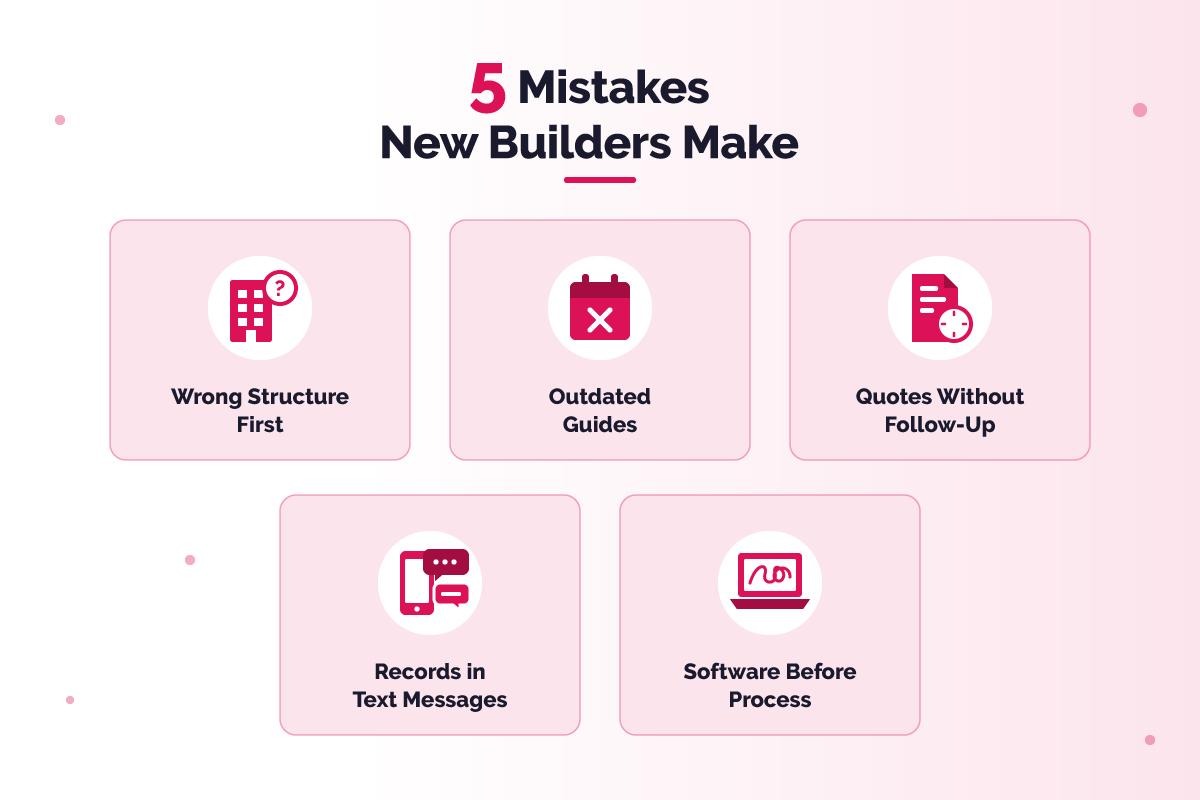
- Registering a structure before checking licence rules. In states that licence companies separately, the wrong structure can mean a second application.
- Relying on an outdated guide. Victoria's regulator changed in July 2025, and licence thresholds change, so always check the regulator's own site.
- Quoting without a follow-up date. A quote with no follow-up is a quote you have already decided to lose.
- Keeping subcontractor records in text messages. It makes TPAR lodgement and compliance checks far harder than they need to be.
- Buying software before you have a process. Decide your pipeline stages and follow-up rules first, then choose the tool that fits them.
Frequently asked questions
Do I need a licence to start a construction company in Australia?
In most cases, yes. Builder licensing is run by each state and territory, not nationally, and the work that triggers a licence differs. In NSW, residential building work worth more than $5,000 needs a contractor licence. In WA, builder work valued over $20,000 needs contractor registration. Check with your regulator before you quote.
How long does it take to get a builder licence?
It depends on your state and licence class. Tasmania lists a processing time of 21 business days for its building services provider licences, while other states set their own timeframes and assessment steps. Ask your regulator for current processing times before you lock in a start date.
What qualifications do I need to become a builder?
Requirements depend on your state and licence class, and they do not carry across borders. In Victoria, for example, the Building and Plumbing Commission notes that the Certificate IV in Building and Construction (Building) is not a prescribed course for any class of registration. Check the requirements for your licence class with your own regulator.
Do I need a white card to run a construction company?
Anyone who carries out construction work needs general construction induction training, known as the white card. If you will be on site yourself, you need one. Your business also has duties to make sure workers hold a white card and receive site-specific inductions.
What software do new construction companies use?
Common options include accounting software, job management software such as Tradify, ServiceM8 or Buildertrend, and a CRM such as HubSpot for enquiries and quote follow-up. The right mix depends on whether your bottleneck is winning work or running it.
What is TPAR in construction?
The Taxable Payments Annual Report is an ATO report that tells the ATO about payments you made to contractors. If your business is primarily in building and construction and you pay contractors, you may need to lodge it by 28 August each year.
Start organised, not catching up
When you start a construction company in Australia, licences, insurance and WHS get you legally on site. A system for enquiries, quotes and follow-up is what keeps work coming once you are there. If you want a second set of eyes on how your new company will capture and convert work, book a Business Growth Audit with our team.